I was jolted out of bed somewhere between three and four
this morning, when my bedroom began shaking violently from side to side. My
first thought was
“not again!” and my second was
“I wish I hadn’t worn those sweatpants
that are so old they are almost transparent to bed!” Just as I was about to put
my shoes on, suddenly the tremor stopped and I breathed a sigh of relief. This
was the kind of earthquake tremor that we had experienced here in
Lodi earlier this January
and we were not at the epicentre. I crawled back into bed and soon passed out,
unaware that I had been near the origin of the earthquake only hours earlier.
When I awoke again, I turned on my computer to discover much
to my horror that the 6. 3 magnitude earthquake had not only struck near the
Emilia Romagna town of Modena,
but that it had also killed at least three people. Apparently it is one of the
largest earthquakes that the region has ever faced and my thoughts are with the
victims and their families.
As some of you may already be aware, the historic Mille Miglia automobile race passed
through both Modena
and Maranello yesterday and I decided to travel to the home of Ferrari for what
may be my last visit in a long time. As I reached my destination, I couldn’t
help but think about all of the things that Ferrari means to me and also what
my time living near Maranello has meant. Being able to keep a promise that I
made to myself when I was a little girl, even if that promise seemed to be a
little crazy has given me this wonderful sense of closure and also rekindled
the feeling inside me that anything is possible.

When I arrived in the town, I headed immediately for my
favourite spot overlooking the Fiorano circuit and after a few moments of
contemplation, decided to make a trek around its perimeter. Fighting past
overgrown grass as rain began to fall and being startled by random animal
noises and abnormally healthy insects, I treated myself to some of Fiorano’s
most spectacular views. I paused in particular in front of Enzo Ferrari’s old
house and couldn’t help but laugh to think of the many times that I have tried
to talk my way passed the security guards that protect the gates to Fiorano or
wondered if I could somehow find a bush with a hole in it. I will miss this
place and all of my random Maranello adventures. After a good hour spent
admiring the track, I emerged from the long grass covered in dirt and certainly
dishevelled looking. It’s like I always say, you know it’s been a good day out
when you are caked in a layer of mud and sweat!
The
Mille Miglia was scheduled to arrive in
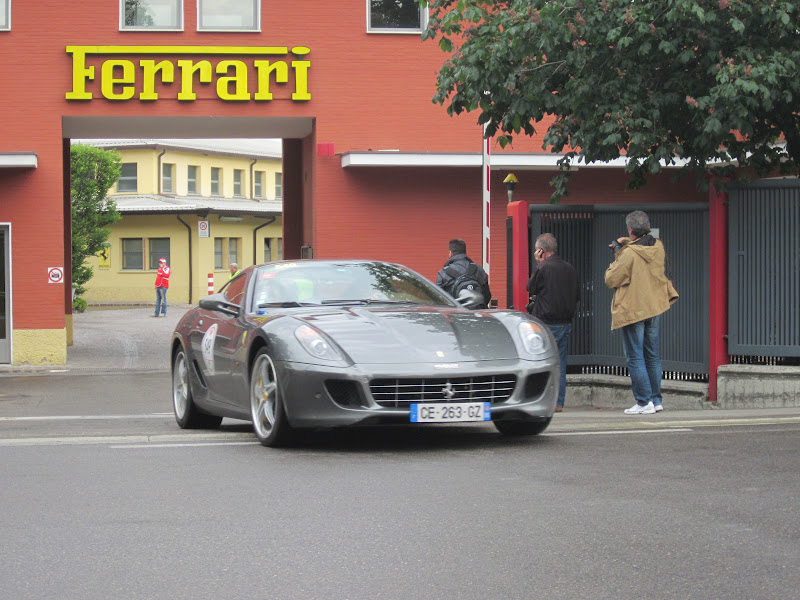
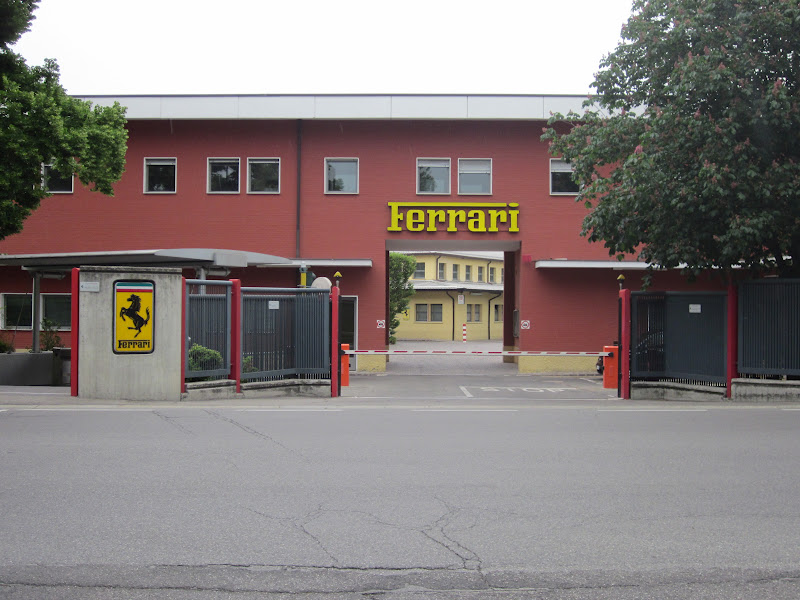
Maranello at around six in the evening but an hour before that, the Ferrari
tribute to the race was set to pass through the historic front gates of the
factory. The
Mille Miglia race is
important to Italian motorsport and to
Modena’s
motor valley in particular, but to Ferrari the race is of special significance.
“The Mille Miglia arouses in me
strong emotions, for this race epitomises long years of my life.” Enzo Ferrari
wrote in his autobiography at the end of a chapter titled simply “Why?”.
“I
have been involved in it first as a competitor, then as the race organizer of
the firm to which I belonged, Alfa Romeo; and, finally, as a car builder –
always filled with admiration for the race itself and its champions. The Mille Miglia, in fact, was a competition
that not only made a decisive contribution to the technical evolution of the
cars themselves, but also revealed who were the real champions. No driver could
call himself complete if his laurels did not include also a victory at Brescia.”
In “My Terrible Joys” which is like a bible to tifosi like
me, Ferrari continues to talk about the race with great fondness. He remembers
funny stories such as the amusing incident when he observed Antonio Ascari’s
mechanic, Sozzi, sweating profusely. Apparently Ascari had made him put pieces
of led sheet in his pockets and shoes when he was found to be nine pounds under
weight.
It seems as though Ferrari was even fond of some of the
race’s strange regulations, such as one which forbid the use of horns. “Every
mechanic carried with him a supply of hammers, bolts, old sparking plugs and
other odds and ends that might be used as projectiles with which to signal to
the driver in front- deafened by his engine- that he should make way for some
one wishing to overtake him. Ah, those races of the heroic days of motoring.”
He concluded.
Sadly for Ferrari, all of his memories of the event were not
so pleasant. The Mille Miglia was
banned in 1957 after two fatal crashes. The first crash involved Ferrari driver
Alfonso de Portago and killed not only the driver and co-driver but also nine
spectators, five of them children. Enzo Ferrari was blamed publically for the
incident and although he was eventually cleared of charges that were lodged
against him, it was a very difficult time for the Italian. Even after such
tragedy, Ferrari’s support for the race and calls to have it reinstated
continued.
In 1977, The
Mille
Miglia became the
Mille Miglia
Storica. Although its latest incarnation no longer showcases the latest
technological advances or provides an arena for the world greatest drivers to
do battle, the
Mille
Miglia still presents a challenge for both car and driver and is a fitting tribute to what was once one of the major
events on the automotive calendar.
Enzo Ferrari was notorious for not wishing to look back but
only to the future of his cars. In fact, he would often scrap old race cars
after they had ceased to be of use to the team. I’m not sure what he would have thought of the modern-day Mille Miglia but for someone like me, who was not around for the dawn of motor racing, it is
a unique opportunity to see historic cars being driven as they were intended to
be, not collecting dust in a museum.
As the time for the arrival of the Mille Miglia approached, a crowd of fans congregated in
front of the factory gates with cameras in hand. I heard many different
languages and accents amongst them; there were the Germans, an elderly British
couple and of course the ever-present tifosi.
Some, I discovered, had been following the cars since they left Brescia on Thursday. One
Italian man standing next to me explained that he follows the Mille Miglia every year and
hopes one day to be able to even participate.
Present too were the
paparazzi, who jostled for position in front of the barriers that had been
erected to block off the street and keep spectators at bay. Several were
extremely aggressive, shouting at one another in Italian.
“Hey, you’re blocking
my shot!” one of them exclaimed.
“I’m just doing my job.” was the slightly
frazzled photographer’s response.
“No you’re not, you’re just being an ass!”
the first
paparazzo hissed with venom.
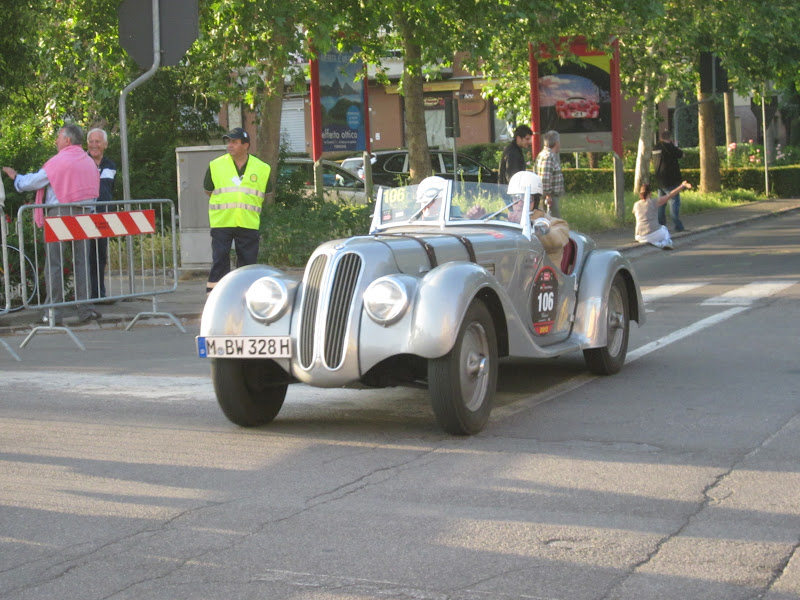
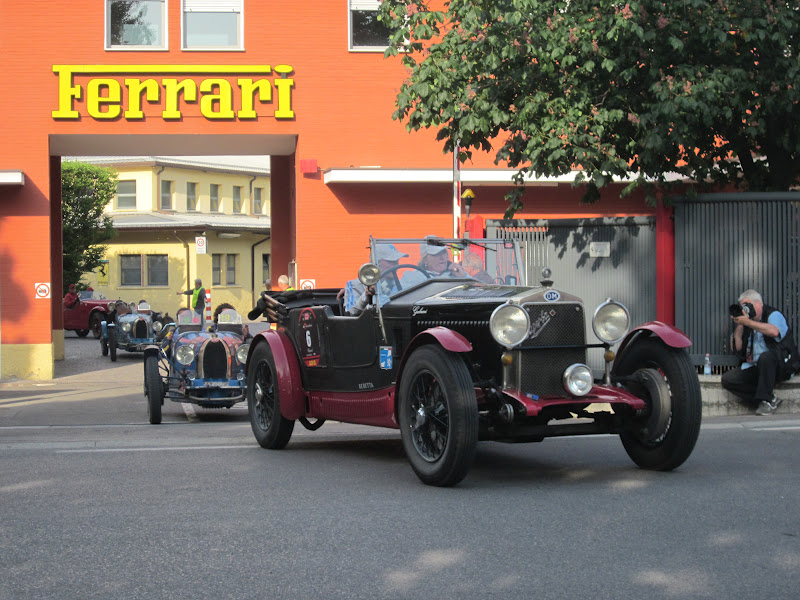
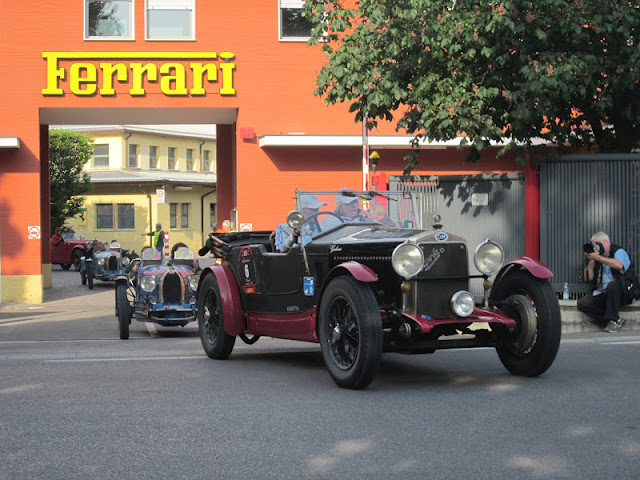
After observing the Ferrari tribute parade of mostly modern
Ferraris pass through the gates of Maranello for quite some time, suddenly the
first historic cars appeared. These were cars that I have only ever seen
stationary before or in books filled with black and white photos, so to observe
them passing right before my eyes in full living colour brought a huge grin to
my face. In addition to the cars, some of the drivers even sported classic
racing goggles and other gear from an era long gone. One by one, the cars made
their way passed the crowd, waving and taking various pictures of their own.


One especially interesting entry was a 1952 Jaguar C-Type which
was piloted by none other than Williams Grand Prix Engineering’s Patrick Head.
He appeared to be enjoying the attention as his entry passed by where I
was standing and the crowd gave him a big cheer as he was recognised. Stirling Moss fans may recognise this particular Jaguar as the car that the legendary driver used in the 1952 Mille Miglia. In fact, sixty years later, Sir Stirling Moss and former Jaguar chief development engineer, Norman Dewis, were reunited once more and drove the car during the race's first leg in Brescia. At the ages of 82 and 91 years old, the pair showed that their passion is as strong as ever.
After several hours of watching beautiful cars from several
different positions near the historic factory gates, I happened to look at my
watch and realised that it was very late. I asked a nearby police officer when
the last bus left for
Modena
and where I could catch it and was informed that the last bus had in fact left.
Faced with the sudden issue of how to get home, I left the
Mille Miglia Storica and wandered into the city centre to find a
taxi or perhaps book a hotel room for the night.
In all honesty, I was freaking out a little bit since I had
on me only ten Euros and was not relishing the prospect of hitch hiking or
sleeping in a field! Luckily for me as I passed several shops I noticed a bus
stop where several people were waiting. One of the women told me that the last
bus was due to arrive in two minutes and just as the words came out of her
mouth, the large blue bus rolled around the corner.
I breathed a huge sigh of relief and assumed position on the
left side; I wanted to see Maranello one more time. As the sun set, the bus
took an unusual route through the town. It wound its way behind the Ferrari
factory where employees usually enter the complex, it passed by people carrying
Ferrari banners as the remaining Mille
Miglia Storica cars arrived and it drove up the hill that overlooks the
Fiorano circuit.
As I looked out the window at the miniature cars circulating
around the track below, I felt a huge sense of gratitude for everything that I
have experienced because of Ferrari. Without a doubt I was sad to leave once
again, but I know in my heart that I will be back one day.